How to Invoice as a Sole Trader in the UK: What HMRC Actually Requires
There is no official HMRC invoice template. People go looking for one, and the reason they can't find it is that the legal requirements for a sole trader's invoice run to about eight lines and would fit on the back of a receipt. The invoice is genuinely the simple part.
What catches sole traders out is everything standing next to it: the address you're obliged to publish if you trade under a business name, the turnover figure that quietly turns you into a VAT collector partway through a year, and the fact that since April 2026 a large slice of self-employed Britain has to keep its income records digitally and file every quarter. This is the UK version. If your clients are American, the paperwork is a different shape and our guide to invoicing as a freelancer in the US covers that instead.
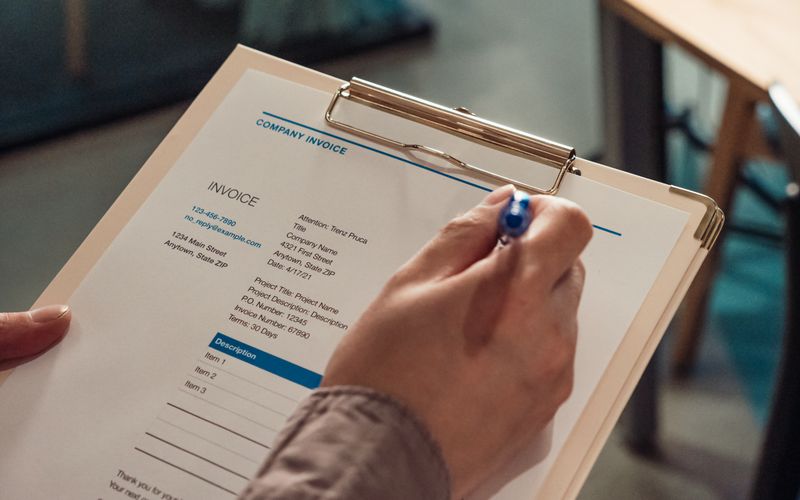
What a sole trader invoice must include
GOV.UK sets out the minimum for any invoice, plus two extra items for sole traders. Get these on the page and your invoice is compliant, however plain it looks:
- The word invoice, somewhere obvious.
- A unique identification number. Any numbering system works as long as no two invoices share a number.
- Your name and any business name you trade under.
- An address where legal documents can be delivered to you, if you're using a business name.
- The client's name and address, and the company name if you're billing a limited company.
- A clear description of what you're charging for.
- The date the work was supplied and the date of the invoice, which are often different.
- The amount being charged, and the total owed.
- VAT, if you're registered for it.
Two things that aren't legally required but that you should put on anyway: your payment terms and your bank details. An invoice without a due date leaves the client to decide when it's late, which they will decide generously. An invoice without sort code and account number leaves them to email you and ask, and that email will sit in someone's drafts for a week.
Descriptions are worth a little more effort than most people give them. "Consulting services, September" gets forwarded to someone with questions. "Brand identity work, 1 to 30 September, 18 hours at your day rate pro rata" gets approved on sight, because the person approving it can see the arithmetic without asking you for it. If you bill by the hour, our guide on turning a timesheet into an invoice goes through how much detail to show.
Your name, your trading name, and the address rule
If you invoice under your own name, this section doesn't apply to you. If you invoice as "Willow Studio" or "Northside Plumbing", it does. Trading under a business name means the invoice has to carry your actual name as well, and an address where legal documents can reach you.
For a lot of sole traders that address is the spare room, which is the uncomfortable bit. The requirement is that documents can be delivered to you there, so a forwarding or office service address you genuinely collect post from satisfies it, while a PO box you never visit doesn't. Plenty of people publish their home address and never think about it again. If you'd rather not, sort it out before you send the first invoice rather than reissuing thirty of them later.
Your business name has limits too. It can't be offensive, can't suggest a connection to government or a local authority, and can't include "Ltd", "Limited", "LLP" or "plc" unless you actually are one. That last one still trips people up who think it looks more substantial.
VAT, and the £90,000 line
Most sole traders never touch VAT, and if your taxable turnover stays under £90,000 you invoice without it. No VAT line, no VAT number, nothing on the invoice about it at all. Charging VAT when you aren't registered means collecting tax you have no authority to collect, and HMRC takes a dim view of it.
The threshold is a rolling one, which is the part people misread. It isn't your tax year or your calendar year. You have to register if your taxable turnover over any previous 12 months goes over £90,000, or if you expect to go over it within the next 30 days on its own, which catches anyone who lands one unusually large project. A good freelance summer can push you over without a single year-end ever showing it.
Once you're registered, your invoices change. A VAT invoice needs your VAT registration number, the rate applied to each item, and the VAT amount shown separately from the net. You also inherit Making Tax Digital for VAT, which has applied to every VAT-registered business since April 2022, so your VAT records have to be kept digitally and filed through compatible software. Registering voluntarily below the threshold is legal and occasionally sensible if your clients are all VAT-registered businesses who reclaim it anyway, though it buys you the paperwork as well.
How to invoice in six steps
1. Agree the terms before you start the work
Payment terms, rate, and what counts as done. Put them in an email if you don't have a contract, because an email is still evidence. The one question worth asking at kickoff, and almost nobody does, is who the invoice should go to and whether their finance system needs a purchase order number on it. An invoice missing a PO number at a mid-sized client can sit unpaid for a month without anyone telling you why.
2. Record the time or the deliverables as you go
Whatever you're billing, capture it while it's fresh. Reconstructing a month of work on the last Friday is where billable hours quietly go missing, and the hours that go missing are always yours rather than the client's. Our guide to tracking billable hours for free covers the options if you don't have a system yet.
3. Close the period before you bill it
Decide what the invoice covers, usually a calendar month, and freeze the record for it. Billing from a set of notes that's still changing is how your invoice and your books end up disagreeing, and how a query in February becomes unanswerable.
4. Number it and build it
Take the next number in your sequence and assemble the items from the checklist above. Sequential numbering isn't legally mandated, only uniqueness is, but sequential is far easier to defend if HMRC ever asks you to account for a year of income, and much easier to spot a gap in. If you don't fancy wrestling a word processor into producing something that looks professional, our free invoice generator needs no account and adds no watermark.
5. Send it to whoever actually pays
Send a PDF, with the invoice number in the subject line, to the address that processes payments rather than the person who briefed you. Your day-to-day contact is usually not in finance and will forward it when they get to it, which adds days to a thirty-day clock you already started.
6. Chase on the due date, not a fortnight after it
Note the due date somewhere you will actually see it, and send a short, pleasant reminder the day it passes. Most late payment in the UK is administrative drift rather than anything worse, and one polite nudge clears the majority of it.
Payment terms, and what the law hands you for free
If you don't agree a payment date, the default under UK law is 30 days from the date the client received your invoice or the goods or service, whichever is later. You can agree something shorter. Fourteen days is common for freelancers, and "due on receipt" is perfectly normal for small jobs. Longer terms are negotiable too, and worth resisting.
When a business client does pay late, you have statutory rights you don't have to write into a contract first. You can charge statutory interest at 8% a year plus the Bank of England base rate, which with the base rate held at 3.75% in September 2026 works out at 11.75%. You can also charge a fixed sum for the cost of chasing: £40 on invoices up to £999.99, £70 from £1,000 to £9,999.99, and £100 at £10,000 or more, once per late invoice. Our guide to charging late payment fees and interest works through the sums.
Most sole traders never invoke any of this, and that's a reasonable commercial decision when you want the client again next year. It's still worth knowing, because a line in your terms saying you reserve the right to charge statutory interest costs you nothing and changes how some finance departments prioritise your invoice.
Records, and what April 2026 changed
Every invoice you send is a record you have to keep for at least five years after the 31 January filing deadline for the tax year it belongs to. That's longer than most people assume, and it's the reason a folder of PDFs with consistent filenames beats a mailbox search every time.
The bigger change arrived on 6 April 2026. Making Tax Digital for Income Tax now applies to sole traders and landlords whose qualifying income is over £50,000, measured from the 2024-25 Self Assessment return. Qualifying income is turnover before expenses, from self-employment and property combined, which is a nastier test than it sounds: someone with £35,000 of freelance income and £20,000 of rent is in, despite neither figure looking close to the threshold on its own.
If you're in scope, income and expenses have to be kept digitally and summarised to HMRC every quarter through compatible software. The Self Assessment return doesn't go away and is still due on 31 January. HMRC put 864,000 people in scope for the first year, and the take-up is worth looking at: by the first quarterly deadline on 7 August 2026, 570,000 had signed up and 436,000 had filed. Roughly half the people who were meant to file that first update didn't.
The threshold drops to £30,000 in April 2027 and £20,000 in April 2028, which is where it stops being a large-trader problem. A sole trader turning over £25,000 will be filing quarterly within two years.
Worth being precise about what software does what here. Quarterly updates have to go through HMRC-recognised MTD software, and that isn't something a timesheet or invoicing tool does for you. What a tool like VibaCloud does is the layer underneath: hours tagged to a client, totalled by project, turned into numbered invoices you can find again. Clean inputs make the quarterly filing a short job rather than a weekend of rebuilding a year from bank statements.
The bottom line
The habit worth building now is the boring one: consistent numbering, a description a stranger could audit, a stated due date, and the record kept somewhere that isn't your sent items. HMRC knocking is unlikely. The reason to bother is that April 2027 pulls everyone over £30,000 into quarterly filing, and April 2028 takes it down to £20,000. Building the habit while it's still optional is a good deal cheaper than assembling it in the fortnight before a filing deadline. Ask the half of the first MTD cohort who missed 7 August.
Frequently asked questions
Do sole traders have to number their invoices?
Yes. GOV.UK requires a unique identification number on every invoice. Nothing forces you to use a sequence, but sequential numbering is easier to check for gaps and easier to defend if HMRC asks you to account for a year of income.
Should I put my UTR or National Insurance number on an invoice?
No. Neither is required and neither belongs on a document that gets forwarded around a client's finance team. An invoice needs your name, any trading name, and contact details. Nothing more sensitive than that.
Can I invoice as a sole trader without being VAT registered?
Yes, and most sole traders do. Below £90,000 of taxable turnover in any rolling 12 months you invoice with no VAT shown and no VAT number. You must not add VAT to an invoice unless you are registered.
How long do I have to keep my invoices?
At least five years after the 31 January submission deadline for the tax year they relate to. Keep the PDFs you sent, not just the figures, because the sent invoice is what a client dispute or an HMRC query actually turns on.
Does Making Tax Digital mean I need invoicing software?
If your qualifying income is over £50,000 you have had to keep digital records and file quarterly updates through HMRC-recognised software since 6 April 2026. The threshold falls to £30,000 in April 2027 and £20,000 in April 2028. Below those figures you can still invoice from a template, though the records have to exist either way.