How to Invoice as a Freelancer in the US: From W-9 to Paid
Nobody becomes a freelancer because they love paperwork, and then the first client asks for a W-9 before they'll even schedule the kickoff call. Invoicing in the US comes wrapped in a small bundle of forms and acronyms, W-9, 1099-NEC, quarterly estimates, that sound more complicated than they are. The invoice itself is the easy part. Knowing what surrounds it is what keeps you organized and paid.
Most of the confusion is about the things that aren't the invoice: the forms that travel alongside it, and whether you owe sales tax on services (usually not, but it depends on your state). Everything below is current for 2026.
What a US freelance invoice must include
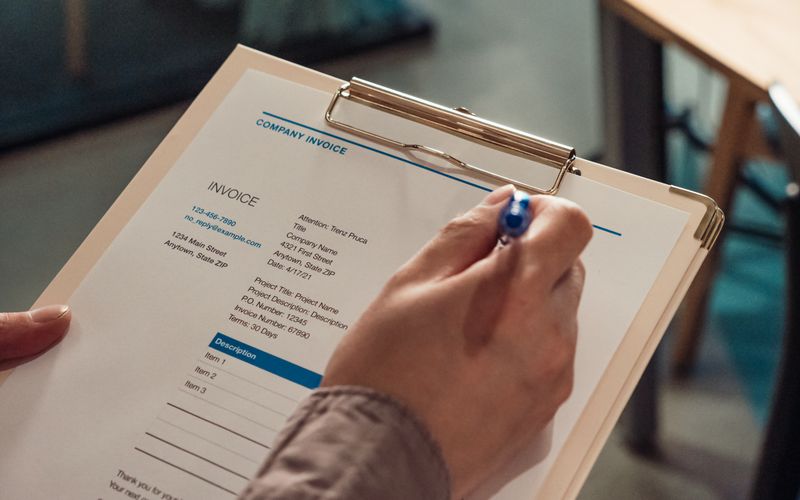
Here is a quiet piece of good news: the US has no legal invoice format. Unlike countries with VAT regimes, no federal law dictates what your invoice must say. What matters is that the IRS expects you to keep accurate records of your income, and your client's bookkeeper expects a document they can approve without emailing you questions. Both are satisfied by the same handful of elements:
- The word "Invoice" and a unique, sequential invoice number (INV-0001, INV-0002 and so on).
- The issue date and an explicit due date, written as a date rather than only "Net 30".
- Your name or business name, address, email and phone number.
- The client's business name and address, plus a purchase order number if they issued one.
- One line per piece of work: what it was, the period it covers, the hours, the rate, and the line total.
- The subtotal, any sales tax that genuinely applies (see below), and the total due.
- Exactly how to pay: ACH details, a payment link, or whatever method you accept.
One thing you should leave off: your Social Security number. Your taxpayer identification details belong on the W-9, which the client keeps on file. An invoice gets forwarded, printed and copied far too freely to carry your SSN around on it.
The paperwork around it: W-9s and 1099-NECs
Before a US business pays you for the first time, it will usually ask you to complete a Form W-9. This is not a tax bill, just a one-page form giving the client your legal name and taxpayer identification number, either your SSN or an EIN. The client keeps it on file so they can report what they paid you at year end. Fill it in once per client, ideally alongside the contract, so your first invoice never sits waiting on missing paperwork.
At year end, the reporting flows back the other way. A business client that paid you $2,000 or more during 2026 must send you (and the IRS) a Form 1099-NEC by late January. That threshold is new: it was $600 for decades, and rose to $2,000 for payments made from January 1, 2026, with inflation adjustments to follow in 2027. The catch every freelancer should tattoo somewhere visible: you owe tax on all of your income whether or not anyone sends a form. A client who paid you $1,500 sends no 1099-NEC under the new threshold, and that $1,500 still belongs on your Schedule C. This is exactly why your own records matter more than the forms: with fewer 1099s arriving, your invoices and your tracked hours become the primary evidence of what you earned.
Do you charge sales tax on services?
Usually not, but it is a state question, not a federal one. Most states do not tax professional and personal services like consulting, design, writing or software development, so most freelancers never add sales tax to an invoice. A minority of states tax services broadly (Hawaii, New Mexico and South Dakota are the well-known examples), and many states tax specific service categories, so the honest answer is: check your own state's department of revenue, or ask a local accountant, once, and then you know. If your services genuinely are taxable where you work, itemize the tax as its own line on the invoice. If they are not, leave tax off entirely. And whatever you do, never write "VAT" on a US invoice; that is a different tax system from a different continent, and it confuses American bookkeepers.
The taxes your invoices need to fund
Your invoice total is not your money. Part of it belongs to the IRS, and no employer is withholding it for you anymore. Self-employed Americans pay self-employment tax of 15.3% on net earnings, covering Social Security and Medicare, on top of ordinary income tax. And because nothing is withheld from your invoices, the IRS expects you to pay as you go through quarterly estimated taxes, due in mid-April, mid-June, mid-September and mid-January if you expect to owe $1,000 or more for the year.
The practical habit that makes this painless: every time an invoice is paid, move a slice, commonly 25 to 30 percent depending on your bracket and state, into a separate tax account before you touch the rest. Freelancers who do this find quarterly deadlines boring. Freelancers who don't find them terrifying. Your invoice records, matched against the hours you tracked, are also what your estimates get calculated from, one more reason the records need to be complete.
How to invoice in six steps
1. Settle the paperwork before the work starts
Agree the rate, the payment terms and the invoicing schedule in writing, and hand over your W-9 with the contract. Some states and cities, New York most prominently, have "Freelance Isn't Free" laws that require written contracts and timely payment for freelance work, so a written agreement is increasingly the norm, not the exception. Every question you settle now is a delay your first invoice never suffers.
2. Track the hours you're going to bill
An invoice is only as good as the record behind it. If you bill by the hour, track time as you go rather than reconstructing the month from memory; if you work with multiple clients, keep every client's time in one system so nothing falls between the cracks. A calendar-native tracker does most of this automatically, since your meetings and work blocks are already scheduled.
3. Close the billing period
Pick the period the invoice covers, usually a calendar month, and finalize the time records for it before you bill. Invoicing from a still-changing record is how the invoice and your books end up disagreeing, and how a client dispute three months later becomes unanswerable.
4. Build the invoice
Assemble the elements from the checklist above: sequential number, dates, both parties, clear line items with the math visible, and the total. "Website redesign, June 1 to 30, 22 hours at your rate" gets approved on sight; "Consulting services" gets forwarded to someone who has questions. If you don't want to fight a word processor into producing something professional, use our free invoice generator, which needs no account and adds no watermark.
5. Send it to the person who pays
Send the invoice as a PDF, to whoever actually processes payments, with the invoice number in the subject line. Larger clients often route invoices through an accounts-payable inbox or portal; asking "where should invoices go, and is there anything they need to reference?" at kickoff saves your invoice a week of internal forwarding.
6. Track it, and follow up on the due date
An invoice you stop watching is an invoice that gets paid late. Track every invoice from sent to paid, and send a short, friendly reminder the day it falls due. Most late payment in the US is inertia rather than malice; one nudge cures the majority of it.
Payment terms that get you paid
Net 30 is the traditional American default, but nothing obliges you to offer it. Net 15 is increasingly common for freelancers, and "due on receipt" is normal for small projects. Shorter terms don't guarantee faster money, but they start the clock sooner and make lateness visible earlier. The numbers say you should expect some friction either way: analysis of over 100,000 freelancers' invoices found that around 29% are paid at least a day late, and the majority of freelancers report waiting more than 30 days for at least some payments.
Three defenses work. First, a deposit, commonly 25 to 50 percent upfront for new clients, which filters out the clients who were never going to pay promptly. Second, a late fee stated in your contract and repeated on the invoice; unlike the UK, the US has no general statutory interest on late business payments, so a late fee only exists if your contract creates it (1.5% per month is a common ceiling, and some states cap it lower). Third, and least glamorous, the follow-up habit from step six. Consistency beats cleverness here.
The bottom line
Invoicing as a US freelancer is three small systems working together: a clean invoice with the math visible, a one-time exchange of paperwork per client (your W-9 in, their 1099-NEC back if you cross $2,000), and a records habit that funds your quarterly estimates and survives any dispute. None of it requires software you pay for. Track the hours, close the period, bill promptly, chase politely, and put a quarter of every payment somewhere the IRS can have it later. The freelancers who get paid on time are rarely the ones with the best clients. They are the ones with the best follow-up.
Frequently asked questions
Do freelancers need to put their SSN on invoices?
No, and you shouldn't. Your taxpayer identification number belongs on the W-9 your client keeps on file, not on an invoice that gets forwarded and copied around their accounts team. An invoice needs your name or business name and contact details, nothing more sensitive.
What is the 1099-NEC threshold for 2026?
$2,000. From January 1, 2026 a business client must send you a 1099-NEC only if it paid you $2,000 or more during the year, up from the long-standing $600 threshold, with inflation adjustments from 2027. You still owe tax on every dollar you earn, including payments below the threshold that never generate a form.
Do I charge sales tax on freelance services in the US?
Usually not. Most states don't tax professional services like consulting, design, writing or development, so most freelancers never add sales tax. A few states tax services broadly and many tax specific categories, so check your state's department of revenue once to be sure. Never add VAT; the US doesn't have it.
What payment terms should a US freelancer use?
Net 30 is the traditional default, Net 15 is increasingly common, and due-on-receipt is normal for small projects. Whatever you choose, write the due date as an actual date on the invoice, state it in your contract, and follow up the day it falls due. Around 29% of freelance invoices are paid late, and a prompt reminder cures most of them.
Can I charge a late fee on overdue invoices?
Only if your contract says so. Unlike the UK, the US has no general statutory interest on late business payments, so a late fee exists only where your agreement creates it. Around 1.5% per month is common, some states cap the rate lower, and stating the fee on both the contract and the invoice is what makes it enforceable in practice.
How much should I set aside from each invoice for taxes?
A common rule of thumb is 25 to 30 percent of each payment, covering the 15.3% self-employment tax plus federal and state income tax, though your bracket and state may move that up or down. Move it to a separate account when the invoice is paid, and quarterly estimated tax deadlines in April, June, September and January stop being stressful.